Showing posts with label apple. Show all posts


2011-03-17


People Are Not Logical About Spending Money

Math MarkImage via WikipediaThis is how I feel about buying apps - The Oatmeal

People are Predictably Irrational. Many people are sadly proud of being bad at math, but most people do not realize how bad our "instinctual" math is. It is easy to get caught in VERY wrong estimates and assumptions.


Enhanced by Zemanta


2009-09-18


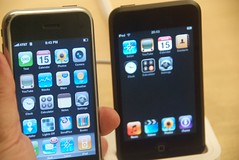
iPod Touch with an Integrated Camera is Still Coming

My hacked (for apps) iPhone & an iPod Touch at...Image by Steve Rhodes via Flickr
Camera-equipped iPod touch still coming, say sources | iPodNN

Rumors said the iPod Touch would get a camera similar to the iPhone 3GS, but it turns out that camera module is too big (thick) for the existing iPod Touch form factor. There was obviously a spot in the new iPod Touch for the same (thin) video-only camera that the iPod nano received. And Steve Jobs says there is no iPod Touch camera, because it is a gaming platform, not a camera.

I think it is clear that someone at Apple (Steve Jobs) decided it did not make sense to include the relatively low quality, video-only camera in the Touch, while the iPhone had a superior camera that could take fairly good stills.  And the Touch is still the easiest way into the Apple App Store, so Apple wants to give consumers every reason to buy one.  They want to capture all the people who will not or can not buy an iPhone and attendant data-plan.

I believe Apple will introduce a new iPod Touch model including the iPhone camera in a case similar to the iPhone itself, or they will introduce an iPod Touch with a different (thin) camera-module that can take at least 2 mega-pixel still photos while still fitting in the existing iPod Touch form.  I personally hope it also comes with the compass and GPS from the iPhone for use with augmented reality, and this might have something to do with the delay.
Reblog this post [with Zemanta]


2009-09-08


Mac OS X 10.6 - Snow Leopard - Resources, Info, and Commentary


NEW YORK - JUNE 11:  A female Snow Leopard pre...Image by Getty Images via Daylife
Having been waiting for the Mac OS X 10.6 Snow Leopard release, I'm happy to say I'm running it now with no real problems. I have included some discussion about both the OS and the coverage below. Here, I am mainly focused on features, expectations/perception, and transitions in the new version.


Scope of Update vs. a Service Pack
A number of web pundits are making noise arguing somewhat derisively that Snow Leopard is more of a "service pack" than a full version upgrade. Personally, I'm a bit surprised by this. The underlying improvements are so significant (see below: 64-bit, OpenCL, and Grand Central), that I do not understand this point of view.

In fact, I believe two factors are at play here: 1) Apple is experiencing some backlash, and it has become fashionable to be down on Apple, and 2) Software manufacturers have been correct in including numerous UI changes and features, because that is what these pundits seem to focus on.


2009-09-02


AT&T's iPhone Deal with Apple


AT&T Mobility LLCImage via Wikipedia

Image representing iPhone as depicted in Crunc...Image via CrunchBase


Recently, there has been a flurry of reports like the link above discussing the possibility the iPhone was a "bad" deal for AT&T. Most of the commentary I've seen seems to take this at face value, even while some disagree with the conclusion. I have yet to see a discussion regarding the possibility of AT&T beginning to spin Wall Street's perception and expectations of the deal prior to the loss of their iPhone exclusivity. And I think this is the most interesting angle.

Some of the facts discussed are interesting in how the WSJ article seems to spin good news into bad. For instance, the article mentions that of the 10 million iPhone activations, "only" 40% were new customers switching to AT&T. That means 4 million new expensive iPhone accounts activated after switching from other carriers (or possibly new cell users). This seems like fairly good news for AT&T.

Concern is also voiced on the relative profitability of iPhone customers due to the ~$400 subsidy on the phone purchase. It is estimated that AT&T brings in $2000 per customer of a two year iPhone contract after the subsidy. The concern centers around two areas: 1) the relatively larger subsidy compared to other "smart" phones with the same high cost data plans, potentially making the iPhone slightly less profitable , and 2) iPhone owners' heavy use of the AT&T data network has caused problems. While the higher subsidy is a real factor, the iPhone's ability to bring in new customers and convert customers to high cost data plans is ignored in this analysis.

I think the affect of the iPhone users on the AT&T data network highlights an issue with the cell carriers: while the cell carriers sell "unlimited" data plans, their data networks are not engineered for actual heavy use. They were designed and built with the prior generation of devices in mind. I think the underlying assumption was that typical cell devices would only be used for e-mail or other spot use. Models before the iPhone were awkward to use for extended periods of time and were not very good for general purpose web browsing. But the iPhone (and some other recent smart phones) has exposed the fallacy in this thinking. If the cell carriers actually believe in a future where handheld (cell-based) devices are primary (or even significant) tools in the use of the Internet, they will need to engineer and build their networks for that load. AT&T is apparently far behind here.

I think there are two factors more at play in the recent articles: 1) AT&T is sensitive to recent criticism and outright jeering over their data network and coverage, and primarily 2) AT&T will soon see the news officially break that it lose its iPhone exclusivity, and they do not want to see their stock collapse when this occurs. So I think it is not unrealistic to think AT&T may be engaging in some spin control to prepare for a time when they lose iPhone exclusivity and many (most?) of those "only" 40% of switching, new customers buying high cost data plans. By minimizing the financial value of the iPhone to AT&T, they attempt to reduce the perceived damage when the news breaks that they are losing the exclusivity.


2009-08-25


Snow Leopard Compatibility: Mac OS X 10.6 Snow Leopard Compatibility List

Uncia uncia.Image via Wikipedia
Snow Leopard Compatibility: Mac OS X 10.6 Snow Leopard Compatibility List
Get ready for Snow Leopard. Check out your apps for compatibility here.
Reblog this post [with Zemanta]


2009-08-15


Mad Men Chooses Apple Distribution Instead of TV (in Canada)

iTunes 7.7, the previous version of iTunes.Image via Wikipedia

MacNN | Mad Men chooses Apple distribution instead of TV

Direct distribution of a television show via iTunes. Could this be a sign of things to come?

Reblog this post [with Zemanta]


2009-05-16


Apple hires former OLPC security head to harden Mac OS X

Apple hires former OLPC security head to harden Mac OS X - Ars Technica

Most articles I've seen are focussed mostly or entirely on what this could mean for Mac OS X on the Mac platform, but I'm intrigued by the parallels with the iPhone/iPod version.

Currently, each app on the iPhone platform runs only with access to its own limited filesystem area with no access to other apps' data. This makes it difficult for apps to work together, but it dramatically reduces the potential impact of some kind of malware. The malware would be restricted to its own area, which does not allow too much mischief.

This is similar though nowhere near as sophisticated as Ivan Krstic's Bitfrost for OLPC. Under this system, each app is virtualized into a sandbox that only allows interactions that are explicitly allowed by the OS. This prevents an app from accessing hardware, software, or data that has not been explicitly allowed thus preventing any malware misbehavior.

While Mac OS X has always been in a much better position than Windows XP (based on smaller market share and underlying design), this hire signals an effort on Apple's part to really take security seriously. This addition could mean great things with the foundation they already have in place. Just as the geek-set have started to point out some of the glaring chinks in OS X's armor, Apple is moving to fix the problems.

Combining Bitfost-type functionality with the existing application signing infrastructure and Mach kernel features could allow Apple to extend and secure their security lead. And as Apple grows their market share in both computers and handhelds, this will continue to become more important. I'm looking forward to see how they implement a slick UI and make this easy yet still safe for users.


Links:


2009-05-05


There Might Be Some Good Reasons for Apple to Buy Twitter

Twitter Mania: Google Got Shut Down. Apple Rumors Heat Up.

While I'd agree it seems an unlikely match for Apple to buy Twitter, there are some interesting possibilities that I haven't seen discussed yet.

Apple's iPhone OS 3.0 will finally include a push data option allowing apps to receive updates while not actually running, thus allowing Apple to continue to disallow background apps (except a few exceptions of their own like iTunes and Mail) on the actual handheld devices themselves. These updates could be IM's, RSS feeds, or various other short messages.

One problem with this model is that it requires servers in the "cloud" to push the updates out to the iPhone or iPod with these servers effectively providing the background processing. And most of the small app developers selling apps in iTunes are not likely to own server farms to provide the servers for an unknown number of users. Twitter's infrastructure, though not without problems, could provide that same functionality for small developers and could scale well.

So, it might be possible that Apple would actually buy Twitter to integrate it with the iPhone's new push updates while nabbing one of the most discussed Internet brands available right now.

There may be other possibilities for integration with Mobile Me, and personally I would love to see some development to provide a centralized notification for use across a wide variety of technologies and standards such as e-mail, RSS, social media, IM's, voicemail, log entries, SNMP, and more. Twitter's infrastructure and popularity could become a clearing house to collect data from a wide variety of sources, both public and private, allowing it to become a universal inbox.


2009-04-05


Mini Payments Are the Future

I believe the future of digital media purchases lies in numerous small cash payments as opposed to a few large scale purchases or token purchases. As examples of future and past, I offer iTunes and Microsoft Office.


iTunes Music, Movies, TV Shows, and Applications
Where iTunes excels is in making things easy to find and easy to purchase. By keeping the unit price low, Apple prevents each purchase from becoming a serious decision. $1 or $2 or even $3 are readily made impulse decisions. The downside is so low, there is almost never a reason to argue against any individual purchase once you have considered it.

If you want something bad enough to actually complete a search for it, you will most likely buy it. There is no commitment associated with such a small purchase. If you find a better app, or another song, there is no regret at that $1-2.


Microsoft Office and Other Expensive Suites
As a contrast, the major investment in Microsoft Office or other large suites forces careful consideration due to the commitment involved. After spending hundreds of dollars on a software package, almost anyone would regret being forced to replace it with another expensive suite performing the same function.

In the past, Office, in particular, has relied on bundling, large enterprise purchases, and proprietary file formats. Bundling becomes more difficult with the average PC price coming down precipitously, and included software and OS licensing becomes a larger fraction of the total cost. Large enterprise purchases have become more difficult due to the lack of new, interesting, and competitive features. And proprietary file formats will eventually go out of style in favor of open standards and previous de-facto standards.

Other expensive suites may be slower to feel these pressures as many, such Adobe's Creative Suite, are used by professionals directly charging for their time. Those suites tend to add additional useful features and functionality, but I believe even they will be vulnerable to numerous smaller packages as integration improves.


2009-03-03


Apple Introduces New Mac Pro with Nehalem Xeon Processors

Apple Introduces New Mac Pro with Nehalem Xeon Processors - Mac Rumors

The New Mac Pro's look great including the new quad-core Xeon "Nehalem"-based processors and the improved component layout allowing for even easier maintenance. Prices aren't too bad at $2499 and $3299 for these high-end models.


Apple releases NVIDIA-based iMacs

Apple releases NVIDIA-based iMacs

This iMac upgrade has been long awaited. I'm happy to see the move to nVidia graphics with 9400M only on the low-end models and GT120 and GT130 on the higher-end versions with optional ATI Radeon HD 4850. And the prices are fairly good starting at $1199 for the only 20" model, $1499 for the "flagship" 24" model, $1799 for the intermediate 24" model, and up to $2199 for the highest-end model.


Apple debuts new Mac minis with five times better graphics

Apple debuts new Mac minis with five times better graphics

The new Mac mini looks to be a very nice upgrade to the low-end machine, especially considering the nVidia 9400M graphics. And with the low power consumption and more eco-friendly construction, I really like the green spin on the marketing, and think this will become more important and more prevalent.


Apple's new AirPort, Time Capsule add dual-band networking

AppleInsider | Apple's new AirPort, Time Capsule add dual-band networking

This appears to be a very nice upgrade for the wifi routers with the guest networking allowing you to give Internet-only access, and the dual band operation should improve performance.

Ars Technica also had a good write-up.


2009-02-25


Introducing Safari 4 - See the web in a whole new way

Introducing Safari 4 - See the web in a whole new way

Apple has release a beta of Safari 4 on Mac and Windows. It looks to be extremely fast. It looks like this new version might break many (all?) Input Manager "plug-ins"/hacks, so be careful.

And here's a link to the nightly WebKit downloads for anyone wanting to use the absolute latest greatest, without having Safari 4 overwrite Safari 3. With a recent Webkit installed, you can run both versions.


Update 1: After briefly testing, I was surprised to find the nightly builds of WebKit are still based on the Safari 3.2.1 . The Safari 4 installation overwrites Safari 3.x, so I'll try it and check if the WebKit builds still use the older version (which is compatible with most modern Input Manager hacks). Or I may be reduced to using Multi-Safari, which should allow you to run a self-contained, older version of Safari/WebKit, without disturbing the primary Safari installation.

In a pinch, if you have problems with Safari 4, you can download Safari 3 again.


Update 2: And it looks like it may be possible to make some Input Managers function. At least I found some instructions which might work for 1Password (a nice password management and archiving utility with an optional iPhone app with wifi sync'ing).


Update 3: You can enable 1Password to function with Safari 4 as mentioned above. Here are specific instructions for the Safari 4 Beta release. And you can re-enable the 1Password toolbar icon by editing your toolbar with View --> Customize Toolbar.


2009-01-08


iPhone's US web presence beats RIM and WiMo combined

iPhone's US web presence beats RIM and WiMo combined

Interesting article on the exploding use of the iPhone and iPod Touch as a mobile platform.  In their relatively short time on the market, they have already begun to dominate in mobile browsing use.

For the first time, I can begin to see how much of our Internet use will move to the smaller mobile platforms.  On the previously available devices, it did not seem realistic.  But the iPhone and iPod Touch make it look reasonable and even likely.


2008-12-23


Mac vs. PC Transformer Video


Cute video of a MacBook Pro and a PC laptop fighting as Transformers.  Well done.

I'm a Mac geek.  I think it is funny.  Hope you enjoy.


2008-10-25


Apple's QuickTime X, Grand Central, OpenCL, and LLVM

Apple's recent publicized patents (link1, link2) and their own pronouncements for Snow Leopard all point toward an exciting combination of technologies. I believe Snow Leopard's QuickTime X will be built on OpenCL which will use LLVM (project, WikiPedia) for general purpose processing in a manner parallel to how Apple already uses LLVM to enhance OpenGL under Mac OS X.

LLVM and OpenCL will allow developers to hand off code and a profile to OS X (probably via Grand Central), and the operating system will find the best way to deal with the request. OpenCL provides the necessary abstraction and LLVM will provide the JIT compiling once the target hardware is determined. This gives the OS a chance to make decisions based on a variety of factors including power usage, other pending requests, realtime/video/audio , CPU/GPU scheduling, and hardware availability.

This makes it easy for developers to take advantage of whatever hardware is available in a particular Mac now or in the future to accelerate processor intensive functions. In addition, it allows the OS and application to handle a variety of situations (e.g. battery vs. power or realtime vs. non-realtime needs).

QuickTime X (along with other frameworks such as Core Animation) will likely take advantage of this to avoid the need to have different plug-ins for different hardware. Mac OS X will handle the processing needs taking best advantage of the available hardware while simplifying QuickTime itself.

This will continue two of Apple's goals:
  1. Giving it's developers an easy way to code complex applications
  2. Providing an available alternative to proprietary frameworks such as DirectX

Apple realized they were vulnerable, if proprietary frameworks took hold and either were not available on the Mac (Direct X) or were available only in a low quality manner (Flash). In recent times, Apple has supported open standards such as MPEG-4/H.264, AAC, and Open GL in an effort to fend off Windows Media and Direct X.

I believe Apple has foreseen the importance of harnessing the power of GPU's and multiple CPU's and does not want to fall victim to a Windows-only standard in this area, so they have created and pushed the OpenCL standard to prevent this. If OpenCL can take hold as a cross platform standard, it is much less likely a proprietary solution will take hold.

Apple is more than happy to compete on price and quality, but they are at a disadvantage if there are certain frameworks or standards that are simply not available on the Mac. By being in the forefront of this important area allows them to continue their present growth without concern of being shut out of this vital area of processing power.


2008-10-14


Apple's New MacBooks and MacBook Pros: Analysis and Opinion

Just in case you've been living in a proverbial cave, Apple introduced new consumer and professional laptops today. Here are a few areas I thought were interesting.


Unibody Construction
The most obvious thing about the new laptops is the new "brick" design, where the main "exoskeleton" of the laptop is machined from a solid block of aluminum. Where all other laptops (including previous models of MacBook Pro) are built with a skin of plastic or metal covering an internal structural skeleton, these new designs eschew the thin exterior with internal bracing in favor of a strong exterior holding all the parts together. I expect these new laptops feel like solid devices and will avoid most or all of the creaks and flexing that make traditionally designed and built laptops feel cheap and fragile. In addition, all the aluminum holding everything together should act a bit like a large heat sink helping to remove heat from the laptop's interior.


Multiple GPU's in the MacBook Pro
While the MacBook receives a massive upgrade in the form of integrated nVidia graphics (GeForce 9400M), the MacBook Pro received the integrated graphics AND discrete graphics (GeForce 9600M GT) with additional processing power. The really nifty part here is hybrid SLI, which allows the MBP to decide which GPU to use based on energy requirements and processing demands.

Presently, it appears you must log out to affect this change (I assume the Window Server must be restarted). But I think the more interesting question is whether both GPU's will be available concurrently for use my OpenCL and Grand Central under Snow Leopard Mac OS X 10.6. If so, that would represent a massive amount of processing power available in a laptop.

If Apple continues to rewrite many of the processor-intensive frameworks such as Core Animation, QuickTime, video compression codecs, and others to take advantage of this power, it will allow for a real change in what is possible in software. All this processing power can make new heavily animated UI features possible and dramatically reduce encoding, decoding, and transcoding time for all forms of media.

The especially nice thing about Apple's Mac OS X architecture and hardware integration is simple: if this kind of power is available in many new Mac's and it is built into the Snow Leopard core frameworks, all these benefits are "free" to the programmer and the consumer. Even old software could benefit from improvements in QuickTime and the frameworks.


Blu-ray and DRM
Contrary to rumor, Blu-ray drives were not included in the new laptops. Some people found this surprising, but I don't understand why. Steve Jobs said Blu-ray was a "bag of hurt" and that it did not make sense to inflict the licensing on consumers presently.

I think there are a few reasons why Apple is not including Blu-ray drives even as options at this point:

1) As in the market in general, the improved video quality is nice but not compelling. The slow uptake in Blu-ray is because upconverted DVD's look very good. The improvement from VHS to DVD was HUGE in both quality and convenience, and there is significant improvement from DVD to Blu-ray, but it is not of the same scale in quality and there is no improvement in convenience.

2) Apple makes money directly and indirectly through video downloads, and HD video downloads are just beginning to pick up steam. Blu-ray is the only remaining competitor to HD downloads in general, and Apple will never make big money on Blu-ray.

In addition, it seems clear that physical delivery will continue to lose sales to downloads and may eventually disappear entirely. Why I like the idea of owning a physical piece of media that cannot be taken from me, the copyright holders would like to have more control. They will continue to push for downloads and streams where they have tight control.

3) And that brings us to the final and perhaps biggest reason: I believe the copyright holders and Blu-ray licensing may force Apple to include large amounts of DRM controls to protect the content from Blu-ray discs much like Microsoft did in Vista with such "wonderful" results. The copyright holders never want to see a repeat of the situation with DVD's, where the encryption was broken and they lost control of the content stored in that format. I would be shocked if they allowed Apple to include Blu-ray video playback without ensuring that there was no way to every get the video into another format, and this may force Apple to make compromises they would rather not make.

FireWire
I find it depressing to see another example of a better technology (FireWire) losing out to a lesser technology (USB). After recently removing FireWire from various iPods, Apple has now released a MacBook that also does not include FireWire. Where I like the less CPU-dependent features of FireWire, the writing has been on the wall for some time.

FireWire has always been a good hard drive connection technology, but much of it's success has been in delivery DV video. With the increasing popularity of MPEG4 H.264 and flash-based video cameras, there is less and less need for FireWire. With no compelling reason to include it over USB (which is good-enough for many things), it will likely disappear as a viable technology over the next few years.


2008-05-28


About the Mac OS X 10.5.3 Update

About the Mac OS X 10.5.3 Update

Apple has released the Mac OS X 10.5.3 update. As usual, it is recommended for all users and has a gazillion fixes and patches.


2008-03-21


Google's New Gmail Code Solves Conflict with Safari 3.1

As we mentioned before, there was a painful conflict between the new Safari 3.1 and the older Gmail code (UI 1) still active for some users. Google is now pushing out the newer codebase, and it appears to solve the problem (at least for us).

As Google, says in their blog post:
How to access what's new:
Just sign in to Gmail. You'll know when you're in new version of Gmail when you see a link for "Older version" at the top right of the screen.
Links:
Gmail blog post - feature list


FYI-YMMV

  © Blogger templates 'Neuronic' by Ourblogtemplates.com 2008

Back to TOP